Nobody who has done it forgets the first morning. It is dark and surprisingly cold when the knock comes; you dress by lamplight, drink coffee under a sky thick with unfamiliar stars, and climb into an open vehicle that noses out into a landscape you cannot yet see. Then the horizon goes grey, then rose, then gold, and the savanna assembles itself out of the dark — and somewhere in it, close, something enormous is breathing. The modern safari has dressed this primal experience in extraordinary comfort. What it has not done, at its best, is dull it.
The safari occupies a strange and interesting place in luxury travel. It is, on one hand, perhaps the most genuinely transformative journey on the menu — the rare trip that returns people changed. On the other, it has a complicated history and a heavy footprint, and the industry knows it. The reinvention of the past two decades has been an attempt to resolve that tension: to keep the wonder while making the enterprise a force for the land and the people it depends on, rather than a drain on them. Whether it has succeeded is a question worth taking seriously, because the answer shapes how, and whether, to go.
The transformationFrom trophy to stewardship
The lineage of the safari runs uncomfortably close to the hunt, and for much of the twentieth century the "luxury" version meant little more than a grander tent and a fuller bar. The decisive shift — the thing that produced the modern safari — was the realisation, by a handful of pioneering operators, that a living animal photographed a thousand times is worth incomparably more than a dead one, and that the only durable way to protect vast wild landscapes is to make them pay their way intact.
From that insight grew the model that now defines the top of the market: private conservancies and concessions, where lodges lease huge tracts of land, employ the surrounding communities, fund the anti-poaching patrols, and cap the number of beds and vehicles so that the wilderness stays wild. The luxury you buy at such a place is not separate from the conservation; it is the mechanism that funds it. Your tariff is, in part, a conservation levy with a beautiful tent attached.
The luxury you buy at the finest camps is the very mechanism that keeps the wilderness wild.
The experienceWhat the new camps get right
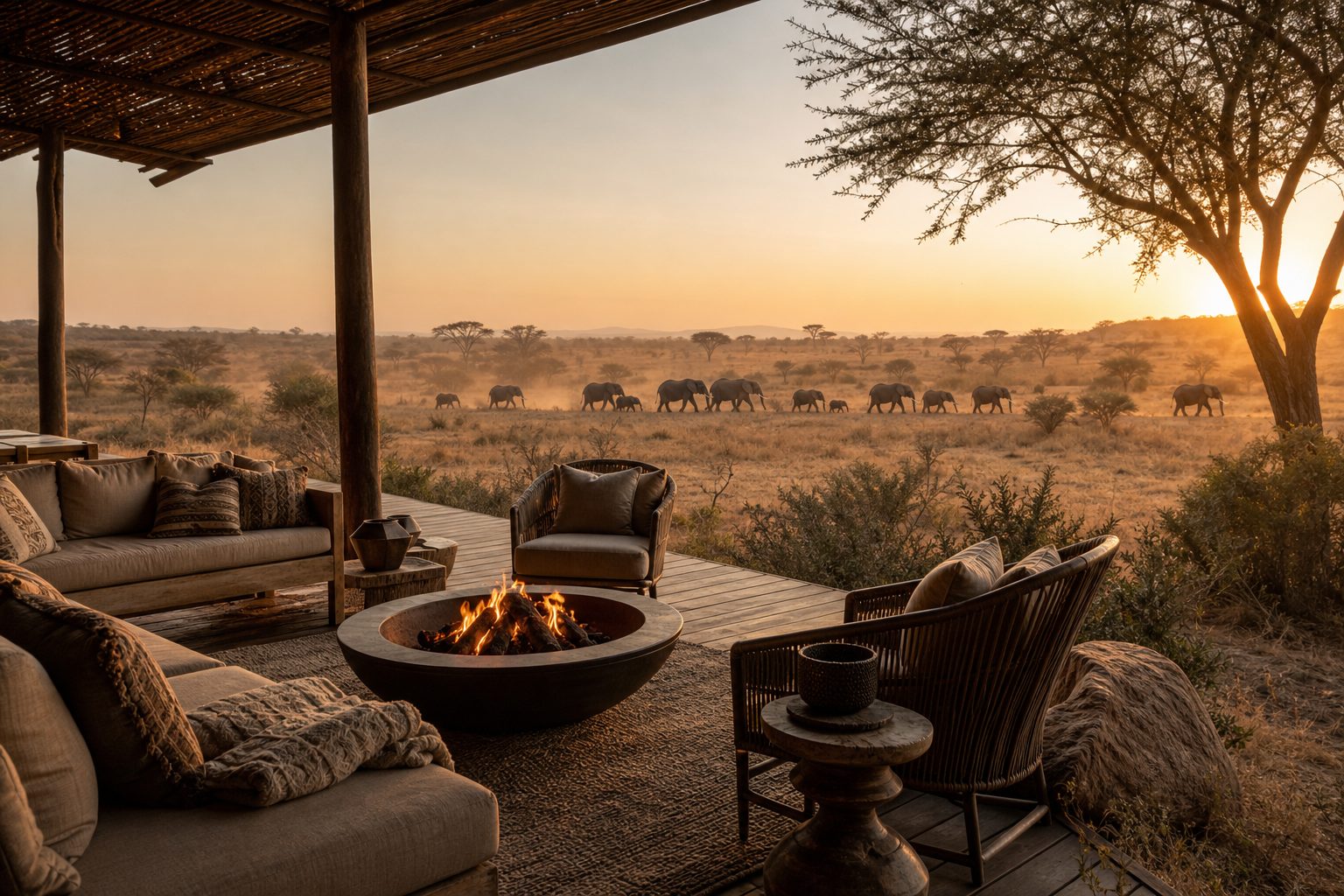
Step into a leading camp today and the first thing that strikes you is the restraint. The great clichés — the mounted heads, the leopard-print everything — are gone, replaced by a pared-back elegance that lets the landscape do the talking: canvas and timber, a deep daybed facing the plain, a plunge pool the colour of the sky, a library of natural-history books, and almost nothing between you and the view. The finest camps feel less like resorts than like exquisitely comfortable observation posts, designed entirely around the act of watching.
The rhythm, too, has been refined to near perfection. You rise before dawn for the first game drive, when the predators are still moving and the air is cold and clean. You return mid-morning to a long brunch and the deep, guiltless idleness of the hot hours — a nap, the pool, the book, the constant low drama of whatever wanders past camp. Late afternoon brings the second drive, the sundowner on a ridge as the light fails, and dinner under the stars with the night noises pressing in. It is a rhythm dictated by the animals rather than the kitchen, and it is one of the most restorative cadences in all of travel.
The guide is the whole trip
If there is one truth the modern safari has fully absorbed, it is that the single greatest variable is the guide. A great guide does not merely find animals — though the finest can read a landscape like a page and put you, again and again, in exactly the right place at the right moment. A great guide changes how you see: turns a static "there's a lion" into an unfolding story of territory and tension and survival, makes the dung beetle as fascinating as the elephant, and sends you home not just with photographs but with a new way of looking at the living world. When people say a safari changed them, they are very often describing the effect of a great guide. Choose the camp, but interview the guiding.
Planning a safari well
- Choose the season for the spectacle you want. The dry season concentrates animals at water and makes for easier viewing; the green season brings birds, newborns and dramatic skies with fewer guests. There is no single "best" time, only the right one for your goal.
- Favour private conservancies. Off-road driving, night drives and walking safaris — often forbidden in the national parks — are usually permitted on private land, and the vehicle density is far lower.
- Stay longer in fewer places. Three or four nights per camp lets the place and its guides work on you; one-night hops waste days in transfers and never let the magic build.
- Mind the small planes. Internal safari flights have strict, low luggage limits, almost always soft-sided. Pack accordingly, and build in buffer time around connections.
- Ask the hard questions. Who owns the land, who from the community is employed and how, and where the conservation money actually goes. The best camps answer instantly and in detail.
The reckoningThe honest costs
A safari is a long way to fly, and the carbon of reaching East or Southern Africa from across the world is real and not to be waved away. The most defensible response we have found is not to pretend otherwise but to weigh it: to go less often and stay longer, to choose operators whose conservation work demonstrably protects large carbon-storing wild landscapes and the species within them, and to recognise that, done right, high-value low-volume tourism is currently one of the few economic forces capable of keeping those landscapes from being converted to farmland or worse.
There is a social reckoning too. The history of conservation in Africa includes the displacement of the very communities who had lived alongside the wildlife for millennia, and the question of who benefits from tourism remains live. The operators worth your money are those who have made the surrounding communities genuine partners and beneficiaries — through employment, through revenue shares, through schools and clinics funded by bed-night levies — rather than fences to be kept out. This is not a detail to research after booking; it is the difference between a safari that helps and one that merely extracts a different way.
Go less often, stay longer, and choose the operators who make the land and its people richer for your visit.
The verdictWhy it remains the great journey
For all the complexity, we send people on safari without hesitation, and we go ourselves whenever we can, because nothing else in travel does quite what it does. To sit in the open at dusk while a herd of elephants files past close enough to hear their stomachs working, to watch a leopard pour itself out of a tree, to feel — genuinely, in the body — how small and recent a thing humanity is against the age of that landscape, is to be returned to a kind of attention most of us have not felt since childhood. It rearranges your sense of proportion. It is, in the most literal sense, awesome.
The modern safari, at its considered best, lets you have that experience while leaving the place stronger for your having come — the patrols funded, the community employed, the reef of grass and acacia kept whole for the next traveller and the generation of animals after that. That is a rare alignment in luxury travel: the thing you most want to do, and the thing the land most needs you to pay for, turn out to be one and the same. Choose your camp by its conservation as much as its comfort, give it your time, and the savanna will give you, in return, a morning you will be telling people about for the rest of your life.